
SS416 Free-Machining Stainless Steel: Properties, Heat Treatment & Applications — The Complete Guide for Buyers

By Starship Alloys | Forged & Rolled Stainless Steel, Tool Steel and Special Alloys

If your production line runs CNC lathes, automatic screw machines, or high-volume turning centres, and you need components with moderate corrosion resistance, there is one stainless steel grade that stands above every other in machining performance: SS416.
With a machinability rating of 85% — the highest of any stainless steel — SS416 cuts like a carbon steel but offers the corrosion resistance of a chromium stainless. For manufacturers producing thousands of shafts, studs, gears, valve stems, and fasteners every month, the difference in machining time and tool life between SS416 and a standard grade like SS410 can translate directly into lakhs of rupees in savings.
At Starship Alloys, we supply forged SS416 round bars and flat bars. In this guide, we will cover everything you need to know about this exceptional free-machining grade — its metallurgy, the science behind its machinability, heat treatment, and how it compares to the alternatives.
What is SS416 Stainless Steel?
SS416 is a martensitic, free-machining stainless steel. It is essentially a modified version of SS410 — the base chemistry is very similar (12-13% chromium, low carbon), but with one critical addition: sulphur.
The addition of 0.15% or more sulphur to the SS410 base composition is what transforms SS416 into a machining powerhouse. The sulphur combines with manganese to form manganese sulphide (MnS) inclusions that are distributed throughout the steel matrix. During machining, these soft MnS inclusions serve two vital functions: they act as internal lubricants that reduce friction between the cutting tool and the workpiece, and they act as chip breakers that cause the machining chips to fracture cleanly rather than forming long, stringy swarf that wraps around the tool and workpiece.
The result is dramatically faster cutting speeds, significantly longer tool life, superior surface finish, and cleaner chip evacuation — all of which translate to lower manufacturing costs and higher production throughput.
SS416 Equivalent Grades — International Cross Reference
Like other major stainless steel grades, SS416 is known by different designations across international standards:
AISI / SAE: 416
UNS: S41600
DIN / EN: X12CrS13
Werkstoff Nr.: 1.4005
JIS (Japanese): SUS416
BS (British): 416S21
GOST (Russian): 20X13
Chinese GB: Y1Cr13
If your client's drawing or purchase specification references any of these designations, they are calling for the same base material. Always confirm the exact chemical requirements and Technical Delivery Conditions, as individual standards may have slightly different tolerance ranges for sulphur content and other elements.
SS416 Chemical Composition
The chemical composition of SS416 as per ASTM A582 (Standard Specification for Free-Machining Stainless Steel Bars) is:
Carbon (C): 0.15% max
Chromium (Cr): 12.00 – 14.00%
Sulphur (S): 0.15% min (typically 0.20-0.35%)
Manganese (Mn): 1.25% max
Silicon (Si): 1.00% max
Phosphorus (P): 0.060% max
Molybdenum (Mo): 0.60% max (optional — added in some variants for improved machinability)
Nickel (Ni): 0.75% max
Iron (Fe): Balance
The role of sulphur — why 0.15% changes everything:

In conventional stainless steels, sulphur is treated as an undesirable impurity and kept as low as possible (typically below 0.030%). In SS416, sulphur is deliberately added as an alloying element at levels 5-10 times higher than in SS410.
This sulphur combines with the manganese present in the steel to form manganese sulphide (MnS) inclusions. These inclusions are soft, grey-coloured particles that are elongated during hot working (forging, rolling) and become distributed throughout the steel in the direction of metal flow.
During machining, when a cutting tool encounters these MnS inclusions, three things happen simultaneously. The inclusions provide lubrication at the tool-chip interface, reducing friction and heat generation. They create stress concentration points within the chip, causing it to break into short, manageable segments rather than forming dangerous continuous ribbons. And they reduce the built-up edge (BUE) formation on the cutting tool, which improves surface finish quality.
The trade-off: Every benefit of the added sulphur comes with a cost. The MnS inclusions that improve machinability also reduce ductility, impact toughness, transverse mechanical properties, weldability, and — to some extent — corrosion resistance compared to SS410. Understanding this trade-off is essential for correct grade selection.
SS416 Mechanical Properties
Annealed Condition:
Tensile Strength: ~520 MPa (75,000 psi)
Yield Strength: ~275 MPa (40,000 psi)
Elongation: ~20%
Hardness: ~155-200 HB (75-85 HRB)
Machinability: 85% (relative to free-machining carbon steel B1112 as 100%)
Hardened & Tempered Condition:
Tensile Strength: ~760-1100 MPa (110,000-160,000 psi)
Yield Strength: ~585-860 MPa (85,000-125,000 psi)
Elongation: ~8-15%
Hardness: 28-40 HRC (depending on tempering temperature)
Physical Properties:
Density: 7.74 g/cm³ (0.280 lb/in³)
Thermal Conductivity: 24.9 W/m·K at 100°C
Coefficient of Thermal Expansion: 9.9 × 10⁻⁶/°C (20-100°C)
Modulus of Elasticity: 200 GPa
Magnetic: Yes — martensitic structure, magnetic in all conditions
A note on transverse properties: Due to the elongated MnS inclusions aligned in the forging or rolling direction, SS416 exhibits noticeable anisotropy. Properties measured in the longitudinal direction (parallel to the forging direction) are significantly better than those in the transverse direction. This is an important design consideration for components subjected to multi-directional loading. Always specify the testing direction when reviewing mechanical test certificates.
Heat Treatment of SS416
Like its parent grade SS410, SS416 is a heat-treatable martensitic steel. The ability to adjust hardness through heat treatment gives engineers flexibility to optimise for different applications.
Annealing
Heat slowly to 815-870°C (1500-1600°F) and hold until uniformly heated. Furnace cool at a controlled rate not exceeding 25°C per hour down to 595°C, then air cool to room temperature.
Expected hardness after annealing: 155-200 HB (75-85 HRB). This is the ideal condition for machining, and the condition in which SS416's exceptional machinability is most fully realised.
Sub-Critical (Process) Annealing
Heat to 650-760°C (1200-1400°F) and air cool. This provides acceptable softness for many operations and is faster and less expensive than full annealing.
Hardening
Austenitise at 980-1040°C (1800-1900°F). Hold for adequate time based on section size. Quench in oil or air cool. Oil quenching is preferred for SS416 to achieve the most uniform hardness, particularly in larger sections.
Important: SS416 is slightly less responsive to hardening than SS410 because the sulphide inclusions act as stress raisers and can nucleate micro-cracks during rapid cooling. For this reason, very aggressive quenching (such as water quenching) should be avoided. Oil quenching followed by immediate tempering is the safest approach.
Tempering
Temper immediately after hardening. Hold at temperature for at least 1 hour per 25mm of thickness, with a minimum of 2 hours.
Tempering temperature vs. hardness (approximate):
200°C → 38-40 HRC (maximum hardness, minimum toughness)
300°C → 35-38 HRC
400°C → 32-35 HRC
540°C → 28-32 HRC
650°C → 25-28 HRC (maximum toughness)
Temper embrittlement warning: Like SS410, avoid the temper range of 425-600°C if impact toughness is critical. This range can cause temper embrittlement in martensitic stainless steels, though the effect is less pronounced in SS416 for applications where impact resistance is not the primary concern.
SS416 vs SS410: When to Choose Which

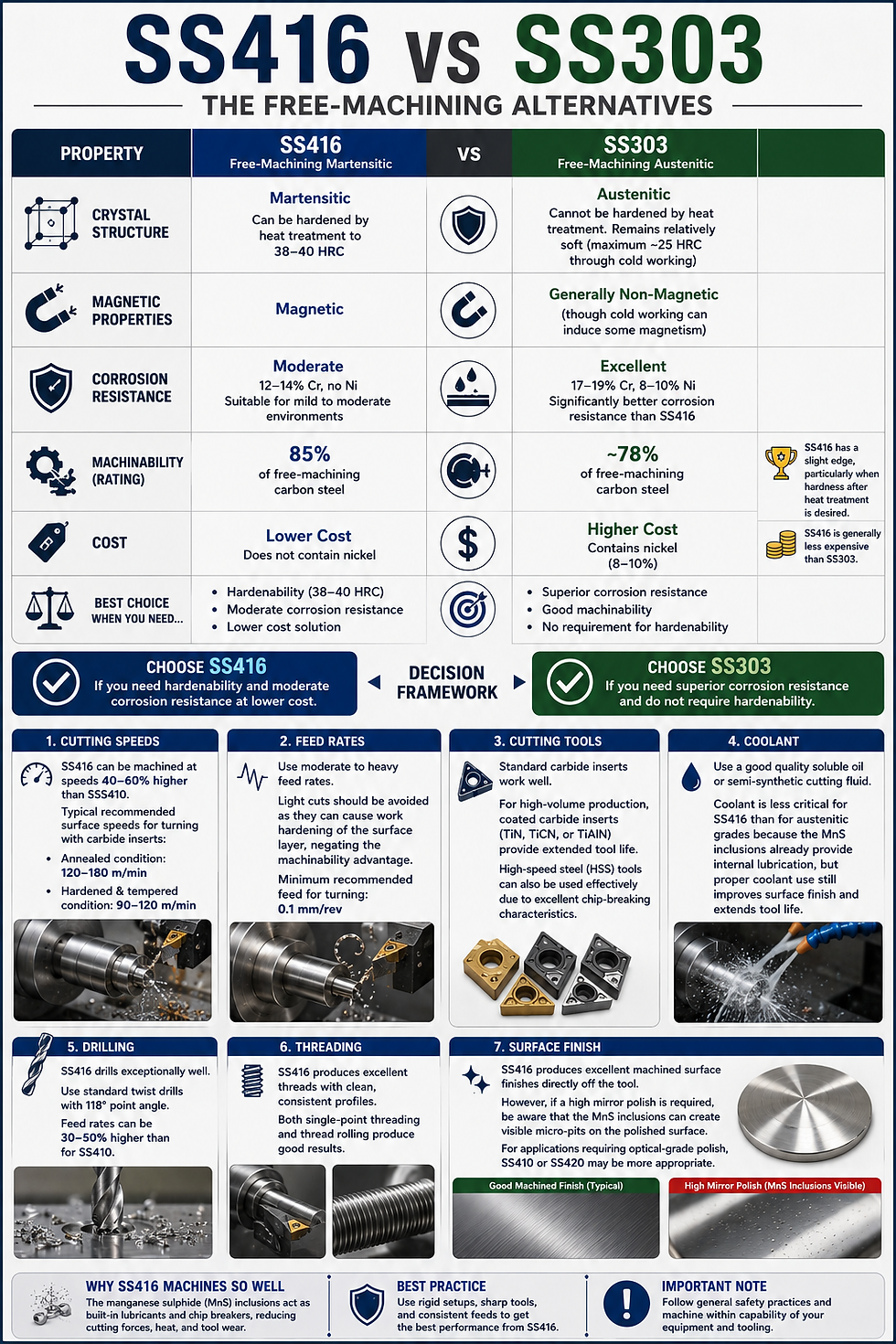
SS416 vs SS303: The Free-Machining Alternatives
Applications of SS416

SS416 is widely used across sectors where high-volume precision machining is combined with moderate corrosion resistance requirements:
Pumps and Valves: Valve stems, valve seats, pump shafts, spindles, and impeller shafts. The combination of hardenability (for wear resistance on sealing surfaces) and machinability (for cost-effective production) makes SS416 ideal for these high-volume components.
Fasteners and Threaded Components: Nuts, bolts, studs, set screws, and threaded inserts produced on automatic screw machines. India's fastener manufacturing sector is a major consumer of SS416 bar stock.
Automotive Components: Fuel injector components, sensor housings, valve guides, and small precision-machined parts for automotive systems. The growing Indian automotive sector drives steady demand for SS416.
Electrical and Electronic Hardware: Motor shafts, solenoid parts, connector pins, and switch components where magnetic properties are acceptable or required.
General Engineering: Gears, bushings, pins, rollers, and wear-resistant precision components across a wide range of machinery and equipment.
Appliance Manufacturing: Washing machine shafts and assemblies, appliance motor components, and other high-volume machined parts.
Instruments and Gauges: Precision components for measuring instruments, gauges, and control devices where dimensional accuracy and surface finish are critical.
Forging SS416 — Process Considerations
SS416 can be forged, though it requires more care than SS410 due to the sulphide inclusions:
Forging Temperature Range: 1150-1230°C (2100-2250°F)
Heat slowly and uniformly to the forging temperature. Do not forge below 930°C (1700°F). The MnS inclusions in SS416 can act as initiation sites for cracking if the material is worked at temperatures that are too low or if excessive deformation is applied in a single pass.
Post-Forging Treatment: Cool forgings slowly in air or in a furnace. Rapid cooling should be avoided as the combination of martensitic transformation stresses and the presence of sulphide inclusions can lead to cracking. After cooling, a full anneal is recommended before any machining.
Reduction Ratio: As with all forged steels, adequate reduction ratio (minimum 3:1, preferably 4:1) is essential to break up the cast structure and achieve uniform distribution of the MnS inclusions. Insufficient reduction can leave clusters of inclusions that adversely affect mechanical properties.
At Starship Alloys, our forging process for SS416 follows the same rigorous sequence as all our grades: EIF melting with LRF treatment, controlled forging with adequate reduction ratio, full annealing, and comprehensive testing at NABL-approved laboratories.
SS416 Available Forms at Starship Alloys
We supply SS416 in the following forged forms:
Forged Round Bars: 80mm Dia to 600mm Dia Forged Flat Bars: 65mm*65mm to 560mm*310mm
Supply Conditions:
Annealed (155-200 HB) — standard supply condition, optimal for machining
Hardened and tempered to customer specification available on request
All material is supplied with complete test certificates from NABL-approved laboratories covering chemical composition (including sulphur content verification), mechanical properties, hardness, and ultrasonic examination results.
Frequently Asked Questions About SS416
Is SS416 the same as SS410? No. SS416 is a modified version of SS410 with added sulphur (0.15% minimum) for improved machinability. While the base chromium content and martensitic structure are similar, SS416 has significantly better machinability but slightly lower corrosion resistance, toughness, and weldability compared to SS410.
Can SS416 be welded? Welding SS416 is generally not recommended. The high sulphur content causes hot cracking in the weld zone. If welding is unavoidable, preheat to 200-260°C, use austenitic filler metal (E309L), and perform a full anneal at approximately 790°C after welding. Even with these precautions, weld reliability is inferior to SS410 welds.
Is SS416 magnetic? Yes. SS416 is magnetic in all conditions — annealed, hardened, or tempered. It has a body-centred cubic martensitic structure, which is inherently ferromagnetic.
What is the maximum hardness achievable with SS416? SS416 can achieve approximately 38-42 HRC after oil quenching from 980-1040°C. This is slightly lower than SS410 (which can reach 40-45 HRC) because the sulphide inclusions slightly reduce the effectiveness of the martensitic transformation.
Is SS416 suitable for marine or offshore environments? No. The sulphide inclusions in SS416 make it susceptible to pitting corrosion in chloride-containing environments. For marine or offshore applications, austenitic grades (SS316L) or duplex stainless steels are recommended.
What ASTM standards cover SS416? The primary standard for SS416 bar stock is ASTM A582 (Free-Machining Stainless Steel Bars). It is also covered under ASTM A276 (Stainless Steel Bars and Shapes) and ASTM A479 (Stainless Steel Bars for Pressure Vessels and General Applications).
What is the density of SS416? The density of SS416 is approximately 7.74 g/cm³ (0.280 lb/in³), which is identical to SS410.
Is there a selenium version of SS416? Yes. SS416Se (UNS S41623) uses selenium instead of sulphur as the free-machining additive. Selenium provides even better surface finish during machining and improved hot workability, but at a higher cost. The selenium variant is less commonly available in India.
Why Source SS416 from Starship Alloys?
Controlled Sulphur Content: The machinability advantage of SS416 depends directly on the correct amount and distribution of sulphur. Too little sulphur and the machining benefit is marginal. Too much and mechanical properties suffer disproportionately. Our melting and forging processes ensure optimal sulphur levels with uniform MnS inclusion distribution.
Forging Expertise: SS416 requires careful forging practice due to the sulphide inclusions. Our controlled forging process with adequate reduction ratio ensures proper inclusion morphology and uniform mechanical properties.
NABL-Approved Testing: Every batch of SS416 includes verified sulphur content in the chemical analysis — this is critical for confirming the free-machining character of the material. Complete test certificates cover chemistry, mechanical properties, hardness, and ultrasonic examination.
Technical Guidance: Not sure whether SS416, SS410, or SS303 is the right choice for your application? Our team understands the trade-offs and can help you select the grade that delivers the best balance of machinability, corrosion resistance, and mechanical properties for your specific requirements.
Get a Quote for SS416 Forged Bars
Whether you need forged round bars or flat bars in SS416 for high-volume machining, valve components, or fastener production, we are ready to discuss your requirements.
Phone: +91 9163 15 0171 | +91 9330 63 5120 Email: mail@starshipalloys.com WhatsApp: +91 9163 15 0171 Visit: www.starshipalloys.com/ss416
Head Office: 190, Girish Ghosh Road, Belurmath, Howrah, West Bengal – 711202, India
Starship Alloys is a Howrah-based supplier of forged and rolled stainless steel, tool & die steel, and special alloys. We serve clients across India with custom-manufactured steel products backed by NABL-approved testing.
Related Reading:


Comments